Decluttering
Home Paperwork: What to Keep, What to Shred, and for How Long
Paperwork accumulates because the decision is genuinely hard: nobody is sure what they are legally required to keep, so they keep everything, forever, in a drawer.
Here is a workable default. It is a general guide rather than professional advice, and if you run a business or have a complicated tax position, your accountant's answer beats this one.
The four-category system
Everything that enters the house is one of four things. Decide as it arrives, not later.
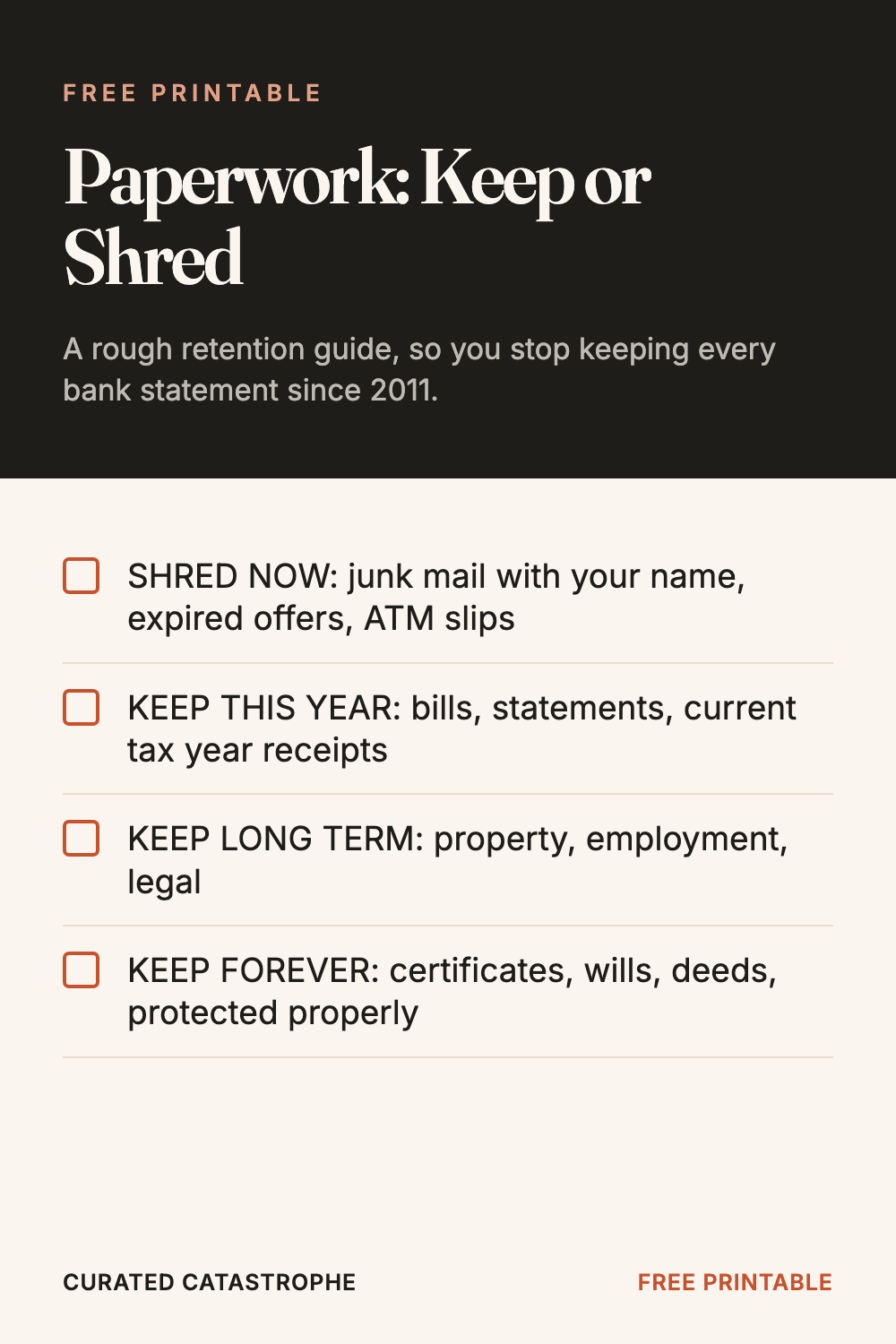
- Shred now. Junk mail with your name on, expired offers, ATM slips, anything with an account
number that you do not need.
- Keep this year. Bills, statements, receipts for the current tax year.
- Keep long term. Documents relating to property, employment and legal status.
- Keep forever, and protect properly. Birth and marriage certificates, wills, deeds.
Four folders. Not a filing cabinet with twenty-six dividers, which nobody maintains past March.
Rough retention guide
- Utility bills and bank statements: around a year, unless needed for tax or a claim.
- Tax records: typically around seven years, and longer if self-employed. Check your own
country's requirement, since this genuinely varies.
- Receipts for large purchases: as long as you own the item, for warranty and insurance.
- Insurance policies: current documents, plus records of any claim.
- Payslips: until you have checked them against the annual summary, then the summary only.
- Property documents, wills, certificates: permanently, and not in a drawer.
Go paperless, but carefully
Most of this can stop arriving in the first place. Two cautions, though:
- Download and store, do not rely on the provider. Banks routinely only keep statements online
for a limited period, and access ends when you close the account.
- Back it up in two places, one of which is not your laptop. A single hard drive is not a
filing system, it is a single point of failure.
The documents that need real protection
Originals of certificates, deeds and wills should be somewhere that survives a house fire or a burst pipe. A drawer does not qualify.
- A fireproof document bag or small safe, which is inexpensive and adequate for most
households.
- Scans stored separately, so replacement is possible even if the originals are lost.
- Tell someone where they are. A perfectly organised set of documents nobody can find is not
much use in the circumstances where it matters most.
Doing the backlog
Do not attempt to sort years of accumulated paper in one sitting.
Take one box, sit in front of the television, and use three piles: shred, keep, and unsure. Do not file anything yet. When the box is done, the keep pile is usually small enough to sort in twenty minutes, and the unsure pile is usually smaller than you feared.
Then do one box a week until they are gone.
What helps
- A cross-cut shredder with a bin large enough that you are not emptying it every ten minutes,
which is the reason most shredding stalls.
- A fireproof document bag for the permanent category.
- A portable document scanner, or just your phone with a scanning app, which is genuinely
adequate.
- Four labelled folders and nothing more elaborate, because elaborate systems are the ones
that get abandoned.
Paperwork: Keep or Shred
A rough retention guide, so you stop keeping every bank statement since 2011.
Download the free PDFSave this for later
Keep reading
- Cleaning schedules
The Realistic Weekly Cleaning Schedule (For People With Jobs)
A weekly cleaning routine built around about 20 minutes a day, designed to be kept rather than admired. Free printable included.
- Cleaning schedules
The Deep Cleaning Checklist, Room by Room (Printable)
A room-by-room deep cleaning checklist split into 45-minute sessions, so you can do it over a fortnight instead of losing an entire weekend.
- Decluttering
How to Declutter Your Whole House Without Losing a Weekend
A room-by-room decluttering plan in 30-minute sessions, with a decision rule that stops you putting everything back.