Cleaning schedules
The Realistic Weekly Cleaning Schedule (For People With Jobs)
Most weekly cleaning schedules you find online assume you have two spare hours every day and a genuine enthusiasm for skirting boards. This one assumes you have a job, possibly some children, and roughly the energy of a damp tea towel by 7pm.
The whole thing runs on about 20 minutes a day, plus a slightly longer reset at the weekend. That is deliberately less than you think you should be doing, because the schedule you actually follow beats the perfect one you abandon in a fortnight.
The principle: one zone a day, not one room a day
Room-a-day schedules fail because rooms are wildly different sizes. "Monday: kitchen" and "Tuesday: hallway" are not comparable jobs, so you fall behind on Monday and give up by Thursday.
Zones fix that. Each day gets a chunk of work that takes roughly the same time, regardless of which room it happens to be in.
The schedule
Every day (about 10 minutes)
These are the three that stop a house sliding, and they are non-negotiable:
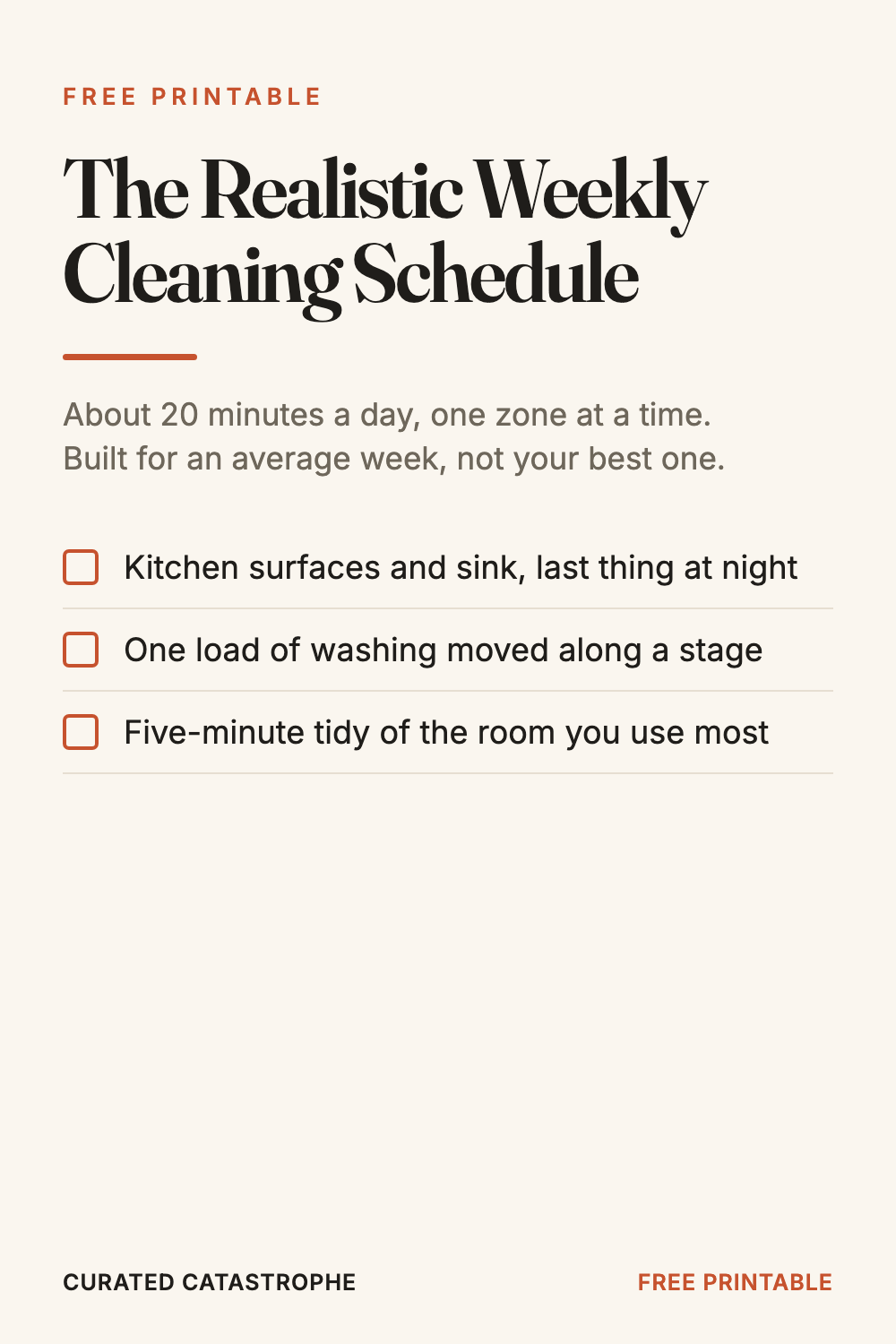
- Kitchen surfaces and sink, last thing at night
- One load of washing moved along a stage, whatever stage it is at
- A five-minute tidy of whichever room you use most
Do these and the house never gets truly bad, even in a week where everything else slips.
Monday: bathrooms
Loo, sink, mirror, a quick pass on the shower. Ten minutes if you are doing it weekly. Forty if you have been ignoring it since March, which is exactly why it is weekly.
Tuesday: floors, downstairs
Vacuum or sweep the main living areas. Skip mopping unless something has visibly happened.
Wednesday: kitchen deep bits
The parts the nightly wipe misses: the front of the cupboards, the hob properly, the microwave interior, the bin. Rotate one appliance a week rather than doing all of them.
Thursday: floors, upstairs and bedrooms
Same as Tuesday, different floor. If you live in a flat, split Tuesday's floors across both days and enjoy the shorter jobs.
Friday: surfaces and glass
Dust the things at eye level, wipe down mirrors and the worst of the fingerprints. Nobody notices dusting. Everybody notices smeared glass.
Saturday: the 20-minute reset
Walk through the house with a laundry basket and return everything to the room it belongs in. Do not put anything away yet. Just get it to the right room, then do a second pass. This is twice as fast as doing it in one go and far less demoralising.
Sunday: nothing
Genuinely nothing. A schedule with no rest day is a schedule you will resent by week three.
Where people go wrong
The most common failure is not laziness, it is over-scheduling. People build a routine for their best week and then feel like a failure in an average one.
Build it for your worst realistic week instead. If a plan survives a bad week, it will sail through a good one, and you get the small satisfaction of being ahead rather than permanently behind.
Two more common traps:
- Cleaning before tidying. You cannot clean a surface covered in things. Always clear first,
then clean, or you will do neither properly.
- Buying storage before decluttering. Storage bought for stuff you were going to get rid of
just makes the clutter tidier and more permanent.
What actually helps
You need shockingly little kit. A schedule fails for reasons of time and motivation, almost never for want of a better spray. That said, a few things genuinely reduce friction:
- A second vacuum, kept upstairs. The single biggest predictor of whether floors get done is
whether you have to carry a vacuum up a flight of stairs. A cheap stick vacuum on the landing outperforms an expensive one in a cupboard.
- Microfibre cloths in bulk. Colour-code them by room so the bathroom cloth never visits the
kitchen. Buying a pack of twenty rather than three is what makes this sustainable.
- A caddy per floor. Duplicating your basic sprays so you are not carrying supplies around
removes the exact bit of friction that makes you skip a job.
- A laundry basket kept solely for the Saturday reset. Not one of your normal ones. It gets
emptied every week by definition.
Adapting it
- Small flat? Merge Tuesday and Thursday, and use the freed day as a second rest day.
- Pets? Add a second floors day. Everything else stays.
- Small children? Move the Saturday reset to a weekday evening. Saturdays rarely survive
contact with family life.
- Shift work? Ignore the day names entirely and just run the seven blocks in order, whenever
your days off land.
The printable
The one-page version has the daily three at the top and the seven day-blocks below, with space to cross things off. It is deliberately plain so it does not look absurd stuck to a cupboard door.
Print it, put it somewhere visible, and give it a fortnight before you decide whether it works. Most routines feel awkward for the first ten days and automatic by day twenty.
The Realistic Weekly Cleaning Schedule
About 20 minutes a day, one zone at a time. Built for an average week, not your best one.
Download the free PDFSave this for later
Keep reading
- Cleaning schedules
The Deep Cleaning Checklist, Room by Room (Printable)
A room-by-room deep cleaning checklist split into 45-minute sessions, so you can do it over a fortnight instead of losing an entire weekend.
- Decluttering
How to Declutter Your Whole House Without Losing a Weekend
A room-by-room decluttering plan in 30-minute sessions, with a decision rule that stops you putting everything back.
- Cleaning schedules
The Monthly Cleaning Schedule Nobody Tells You About
The jobs that need doing every four to six weeks, the ones that quietly make a house feel neglected when they slip. One page, twelve months.